Choosing the right flooring solution is a critical decision for commercial projects. From office buildings and hotels to airports, cinemas, and public facilities, flooring needs to balance durability, design flexibility, maintenance costs, and long-term performance.
Two of the most popular commercial flooring options are broadloom carpet and carpet tiles.
But when comparing broadloom vs carpet tiles, which option is better for your project?
The answer depends on your application, budget, installation requirements, and maintenance expectations.
As a professional commercial carpet manufacturer, QIANQIAO Carpet provides customized flooring solutions, including high-performance broadloom carpets and modular carpet tiles for global commercial projects.
In this guide, we will compare:
- What is broadloom carpet?
- What are carpet tiles?
- Key differences between broadloom and carpet tiles
- Which flooring solution is better for commercial spaces?
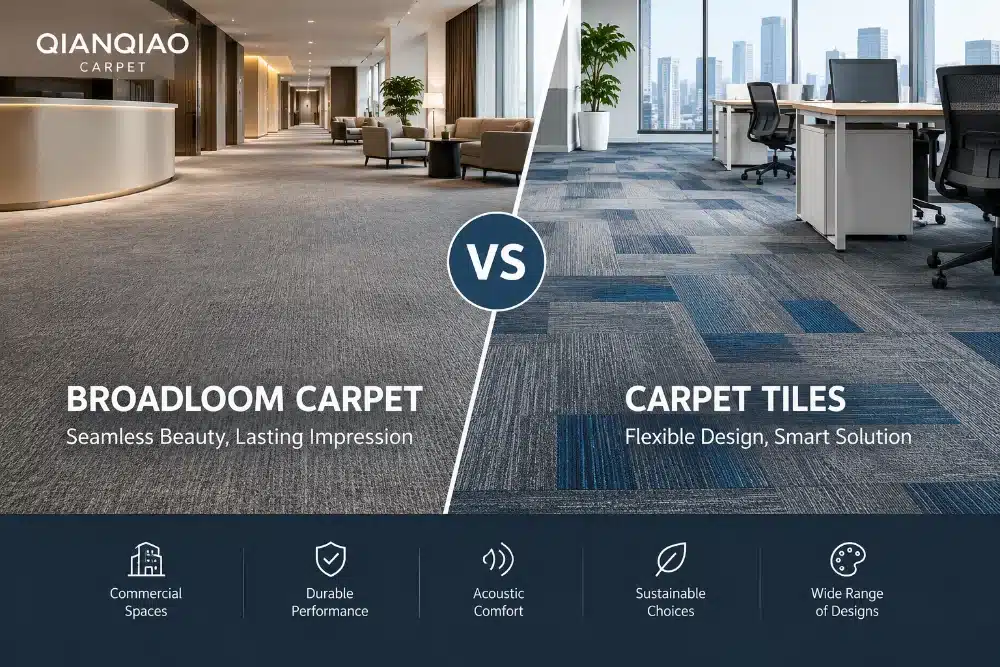
What Is Broadloom Carpet?
Contents
ToggleBroadloom carpet is a continuous roll carpet manufactured in large widths, typically installed wall-to-wall to create a seamless flooring appearance.
It is widely used in:
- Hotels
- Conference centers
- Luxury offices
- Casinos
- Cinemas
- High-end commercial interiors
Because broadloom carpet creates a smooth and uninterrupted surface, it provides a premium visual effect that is difficult to achieve with modular flooring.
Advantages of Broadloom Carpet
1. Seamless and Luxury Appearance
One of the biggest benefits of broadloom carpet is its elegant appearance.
With fewer visible seams, broadloom carpet creates a continuous pattern and sophisticated look, making it ideal for:
- Hotel lobbies
- Ballroom areas
- Executive offices
- Premium hospitality spaces
Custom designs, patterns, and colors can also be produced to match architectural concepts.
2. Superior Design Flexibility
Broadloom carpets offer excellent design possibilities, including:
- Custom patterns
- Brand logos
- Special color combinations
- Custom textures
For luxury projects requiring a unique interior identity, broadloom carpet is often the preferred solution.
3. Comfortable and Quiet Flooring
Commercial buildings often require acoustic performance.
Broadloom carpet helps:
- Reduce walking noise
- Improve room comfort
- Create a warmer interior atmosphere
This makes it suitable for hotels, offices, libraries, and entertainment spaces.
What Are Carpet Tiles?
Carpet tiles, also called modular carpet tiles, are individual carpet squares or planks designed for flexible installation.
Common sizes include:
- 50cm × 50cm carpet tiles
- 60cm × 60cm carpet tiles
- Custom modular sizes
They are widely used in:
- Corporate offices
- Schools
- Retail spaces
- Airports
- Public buildings
Advantages of Commercial Carpet Tiles
1. Easy Installation and Replacement
One major advantage of commercial carpet tiles is easy maintenance.
If one area becomes damaged or stained, individual tiles can be replaced without removing the entire floor.
This reduces:
- Repair costs
- Downtime
- Maintenance difficulty
2. Lower Lifecycle Costs
Although initial costs may vary, carpet tiles often provide better long-term value because damaged sections can be replaced individually.
For high-traffic commercial areas, this can significantly reduce maintenance expenses.
3. Flexible Design Options
Modern carpet tiles are available in many:
- Colors
- Patterns
- Textures
- Layout combinations
Designers can create unique flooring concepts by mixing different tile styles.
Material Science: Engineering for High Traffic
Regardless of the format you choose, the secret to a successful installation lies in the fiber. At the Qianqiao Carpet factory, we engineer our high traffic commercial carpet using three primary materials:
Nylon 6.6: The king of synthetic fibers. It offers the highest resilience and abrasion resistance, making it perfect for busy office corridors and airport terminals.
80/20 Wool-Nylon Blend: The heritage choice for luxury hospitality. The wool provides natural flame retardancy and soil resistance, while the nylon ensures the carpet can withstand the rolling loads of luggage carts.
PET Polyester: A sustainable, eco-friendly option derived from recycled materials. PET is naturally stain-resistant and holds color exceptionally well, helping projects achieve LEED certification.
Broadloom vs Carpet Tiles: Key Differences
| Feature | Broadloom Carpet | Carpet Tiles |
|---|---|---|
| Installation | Professional installation required | Faster modular installation |
| Appearance | Seamless luxury look | Flexible modern design |
| Replacement | Requires larger repair area | Individual tiles replaced |
| Maintenance | Higher repair complexity | Easy maintenance |
| Design | Large custom patterns | Mix-and-match designs |
| Best For | Hotels, luxury spaces | Offices, high-traffic areas |
| Waste Reduction | More cutting waste | Less material waste |
Broadloom vs Carpet Tiles: Which Is More Durable?
Both options can provide excellent durability when using high-quality commercial carpet materials.
However, durability depends on:
- Fiber type
- Carpet construction
- Traffic level
- Maintenance program
For example:
- Nylon carpet offers excellent abrasion resistance for heavy commercial use.
- Solution-dyed polyester provides strong stain resistance.
- High-density construction improves lifespan.
For busy office environments, airports, and public spaces, commercial carpet tiles are often preferred because damaged sections can be replaced quickly.
For luxury hospitality projects, broadloom carpet remains a popular choice due to its premium appearance.
Carpet Tiles vs Broadloom: Which Is More Cost Effective?
The total cost of flooring includes:
- Material cost
- Installation cost
- Maintenance cost
- Replacement cost
- Lifespan
Broadloom Carpet Cost Considerations
Broadloom carpet may require:
- Professional installation
- Precise measurements
- More preparation work
However, it provides a premium appearance suitable for high-end projects.
Carpet Tile Cost Considerations
Carpet tiles usually offer:
- Faster installation
- Easier repairs
- Lower maintenance costs
For large commercial buildings with heavy foot traffic, carpet tiles can provide better lifecycle value.
Conclusion
When comparing broadloom vs carpet tiles, there is no single solution that fits every commercial project.
- Choose broadloom carpet for luxury appearance, seamless design, and premium hospitality projects.
- Choose commercial carpet tiles for flexibility, easy maintenance, and high-traffic environments.
By understanding your project’s requirements, you can select the flooring solution that delivers the best balance of performance, aesthetics, and value.
QIANQIAO Carpet provides customized commercial carpet flooring solutions for offices, hotels, cinemas, and global architectural projects.
Frequently Asked Questions
What is the difference between broadloom carpet and carpet tiles?
Broadloom carpet is installed as a continuous roll, creating a seamless appearance, while carpet tiles are modular pieces that allow easier replacement and maintenance.
Are carpet tiles better than broadloom carpet?
Carpet tiles are often better for high-traffic commercial spaces because they are easier to maintain and replace. Broadloom carpet is better for projects requiring a luxury seamless appearance.
Which carpet is best for commercial buildings?
The best commercial carpet depends on the application. Offices often use carpet tiles, while hotels and luxury interiors commonly choose broadloom carpet.
Are carpet tiles cheaper than broadloom carpet?
Carpet tile costs vary depending on materials and design. However, carpet tiles often provide lower lifecycle costs because individual damaged tiles can be replaced.
Related Carpets